Custom Software for Startups: Why Off-the-Shelf Falls Short

If you're running a startup with no website yet, you've probably been told to "just use" a template builder, a CRM plugin, or an off-the-shelf platform to get moving fast. That advice works for a weekend project. It rarely works once your business starts doing anything even slightly non-standard — a specific pricing model, a custom workflow between teams, or an integration between tools that were never designed to talk to each other. Off-the-shelf software is built for the average business. Startups are rarely average, and the gap between what a generic tool offers and what your business actually needs is exactly where growth gets stuck.
Key Takeaways
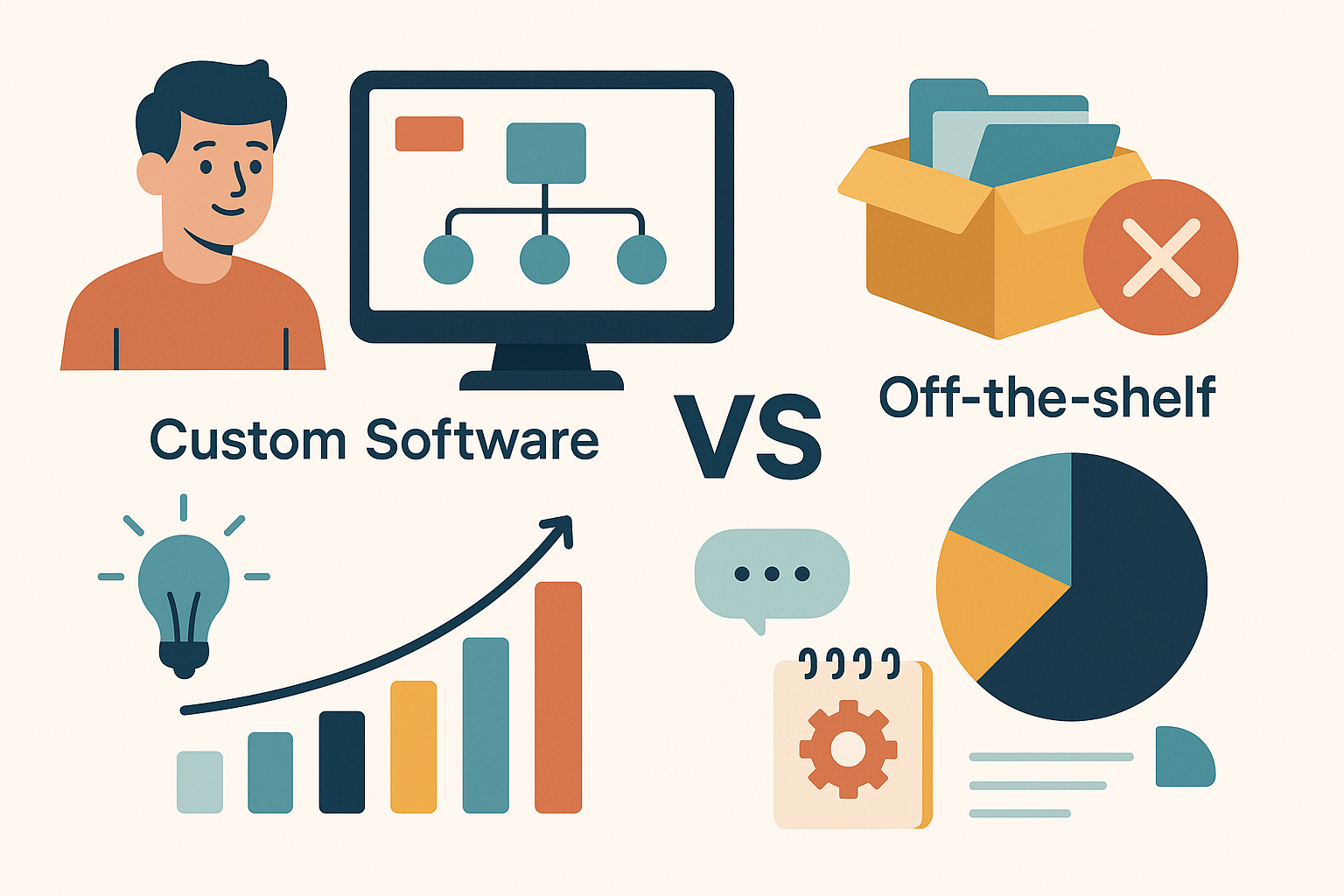
- Off-the-shelf tools are built for the widest possible audience, not your specific workflow, pricing, or customers.
- Startups often hit a wall where plugins, workarounds, and manual fixes cost more time than building it right once.
- Custom software becomes worthwhile when a business process is unique, repeated often, or tied directly to revenue.
- A single senior team handling design, build, and launch avoids the handoff gaps common in larger outsourced projects.
- Starting with a focused, working system — not a bloated platform — lets a startup grow into its software instead of around it.
Why Off-the-Shelf Software Breaks Down as a Startup Grows
Ready-made platforms exist because most businesses share common needs: taking payments, sending emails, storing customer records. For the first few months, that overlap is enough. The problem starts when your business needs to do something the tool wasn't built for — and you find yourself bending your business to fit the software, instead of the other way around.
The workaround trap
Most founders don't notice the shift at first. It looks like small compromises: a manual spreadsheet to track something the CRM can't handle, a Zapier chain connecting three tools that barely cooperate, a support rep copying data between systems by hand. Each workaround feels minor. Together, they become a second, invisible job — one that grows with every new customer instead of getting easier.
Paying for features you don't use, missing the ones you do
Off-the-shelf platforms are priced and built for a broad market, which means you're often paying for modules you'll never touch while the one feature your business actually depends on isn't there at all. This is a known trade-off in commercial off-the-shelf software: it optimizes for broad compatibility, not for your specific process.
Technical debt you didn't choose
Stacking plugins and third-party tools on top of each other creates fragility. One update to a tool you don't control can break a workflow your whole team relies on. Over time, this accumulates into what's often called technical debt — except in this case, it's debt you inherited from someone else's software roadmap, not your own decisions.
When Custom Software Actually Makes Sense for a Startup
Custom development isn't the right call for every startup, and it's not meant to replace every tool you use. The question isn't "off-the-shelf or custom" as a blanket rule — it's whether a specific part of your business is unique enough, and important enough, to justify building it properly.
Your business logic is genuinely different
If your pricing, onboarding, booking flow, or internal approval process doesn't match how any standard SaaS tool expects it to work, you'll spend more time fighting the software than running your business. Custom software is built around your actual logic — the way your business really operates, not the closest generic template.
The workflow touches revenue or customers directly
A slow internal report is annoying. A checkout flow, a booking system, or a client dashboard that doesn't fit your business can cost you customers. When software sits directly between you and revenue, the cost of "good enough" gets much higher — and the case for building it right, once, gets much stronger.
You're duct-taping multiple tools together
If your current setup is three or four different platforms connected through fragile integrations, each one a potential point of failure, that's usually a sign the underlying need was never really "off-the-shelf" to begin with. A single system — web, mobile, or backend — designed around your actual workflow can replace that patchwork with something that's actually yours: no license fees for features you don't use, no dependency on someone else's update schedule.
You have no website at all yet
For startups building their first web presence from scratch, this is the moment to decide the foundation deliberately. A generic template might get a page online quickly, but if the plan is to add bookings, a client portal, an app, or AI-driven features later, starting with a system designed for that future costs less than migrating away from a rigid template down the line.
What Building Custom Software Actually Looks Like
A lot of founders avoid custom development because they imagine it means a large agency, a long contract, and months of meetings before anything gets built. That's not the only way to do it. LegoTech, based in Tel Aviv, works differently: one senior team designs, builds, and launches the system — web, mobile, and AI — without handing the project between departments or junior staff along the way.
One team, start to finish
A common source of delay and miscommunication in software projects is the handoff — one team designs it, another builds it, a third one deploys it, and details get lost at every transition. When a single senior team owns the whole process, from the first conversation about how your business actually works to the day the system goes live, there's no translation gap. What was designed is what gets built.
Web, mobile, and AI as one system, not three separate ones
Startups often need more than a website. A customer-facing site, a mobile app, and increasingly, an AI-powered feature — a smart search, an automated response system, a recommendation engine — work best when they're built as parts of one connected system rather than three separate projects stitched together after the fact. That's the kind of work LegoTech focuses on: custom web, mobile, and AI systems built around a specific business, for companies working across different markets.
Starting focused, not building everything at once
Custom doesn't mean building every feature you can imagine on day one. A working system that handles your core process well — the booking flow, the client dashboard, the checkout — gives you something real to launch with and grow from. Trying to build a fully-featured platform before you have real users to test it against is how projects stall. Startups compare notes on this constantly in communities like Y Combinator's startup library, and the pattern repeats: focused first versions beat sprawling ones.
Frequently Asked Questions
Is custom software more expensive than off-the-shelf tools?
Upfront, often yes — off-the-shelf tools usually have a lower starting cost because that cost is spread across many customers. But off-the-shelf pricing rarely stays simple: added seats, premium tiers, and third-party integrations add up. Custom software is a one-time investment in something built specifically for your business, with no recurring license fees for features you don't need.
How do I know if my startup actually needs custom software, or if a standard tool is enough?
Look at where you're spending manual time right now. If it's a handful of small annoyances, a standard tool is probably fine. If you're maintaining spreadsheets, manual workarounds, or multiple connected tools just to make one core process work, that's usually the sign a custom system would pay for itself.
Can custom software still be launched quickly for a startup with no website yet?
Yes — starting from a focused version of the system, built around your core process, is generally faster than trying to configure a generic platform to do something it wasn't designed for. Building web, mobile, and AI pieces as one connected system from the start also avoids the delays that come from stitching separate tools together later.
What does "built around your business" actually mean in practice?
It means the software follows how your business actually operates — your pricing model, your customer flow, your internal process — rather than asking your business to adapt to a generic tool's assumptions. LegoTech designs, builds, and launches these systems as one senior team, working with companies across different markets from its base in Tel Aviv.